Introduction
Most CRM migrations do not fail because the data did not move. They fail because the team did not. By the time the dashboards are green and the pipelines are imported, the average B2B sales organization has already lost two full quarters of velocity — not to a broken integration, but to a broken habit. Reps keep logging activities the way they did in the old system. Managers keep forecasting from gut feel. Marketing keeps throwing leads over the same invisible wall. The new platform becomes an expensive mirror of the one it replaced.
In 2026, that tax is unaffordable. AI-native CRMs are no longer a line on a roadmap — they are the operating system of every high-velocity revenue team that outpaced its market this year. They auto-log calls, predict churn weeks before it shows, and route deals to the right rep without a manager touching a rule. But none of that compounds if the migration itself is handled like a 2019 project plan.
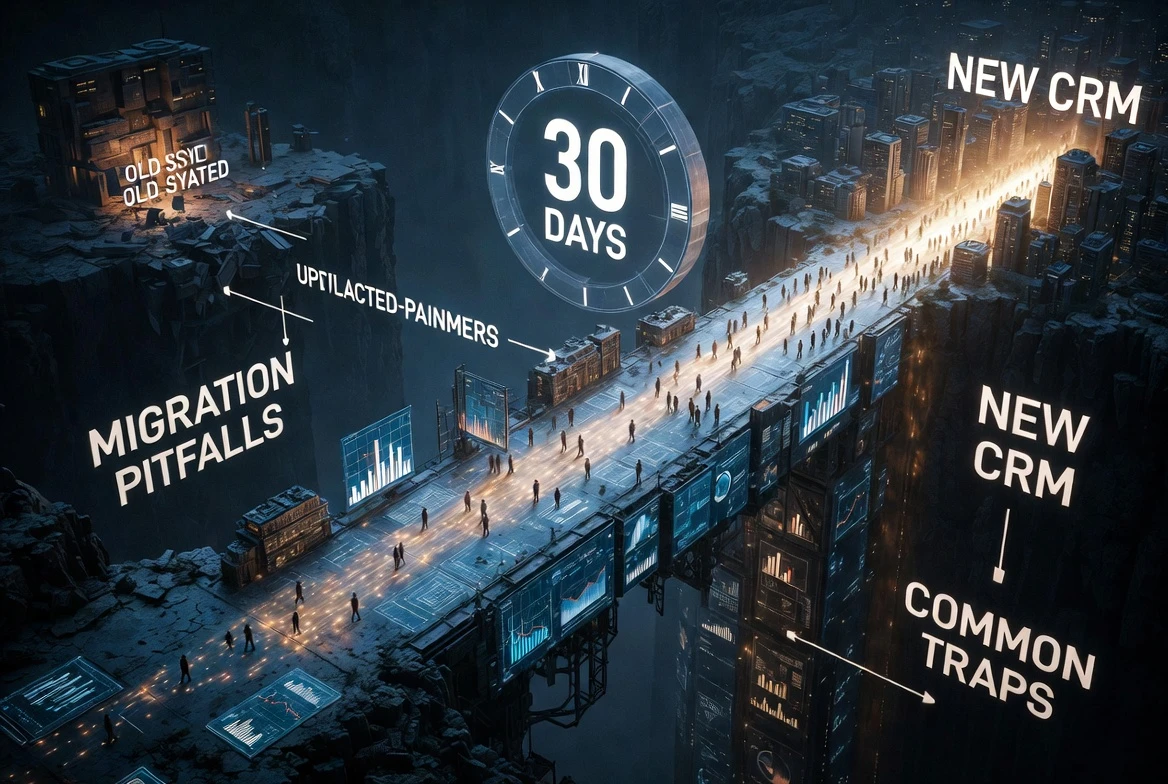
This is the 30-day playbook used by B2B teams that moved from Salesforce, HubSpot, and Dynamics to AI-native platforms without losing a single quarter of pipeline. It covers the three things most migration guides skip: the adoption mechanics that determine whether reps actually change behavior, the data mapping decisions that lock in or destroy future AI accuracy, and the common pitfalls that quietly sink the majority of CRM switches in their first year. Read it once before you kick off — and reference it every Monday for the next four weeks.
What Legacy-to-AI-Native CRM Migration Actually Means in 2026
A legacy CRM is a system of record. An AI-native CRM is a system of action. The difference is not cosmetic — it is architectural. Legacy platforms were built around a relational database that reps manually fed: contacts, accounts, opportunities, activities. Every insight was a report someone had to build, and every workflow was a rule someone had to maintain. The AI layer, when it existed, was bolted on top as a feature flag.
An AI-native CRM inverts that stack. The intelligence sits in the core — ingesting emails, calls, meetings, product usage, and support tickets in real time — and the interface surfaces the next best action instead of the next empty field. Reps do not update the pipeline; the pipeline updates itself and asks them to confirm. Managers do not chase forecast calls; they review a probabilistic forecast the system already assembled. Data mapping stops being a one-time ETL job and becomes a continuous signal layer.
This shift is no longer prospective. By the end of 2025, AI-native platforms crossed the adoption threshold that legacy suites took two decades to reach, and the fastest-growing B2B companies of 2026 are running on them. Teams still sitting on legacy CRMs in Q3 of this year are not being conservative — they are quietly falling behind on win rates, ramp times, and retention forecasts that their competitors already treat as solved problems.
How AI-Native CRM Works at Every Stage of the Funnel
Top of Funnel: Autonomous Lead Scoring and Enrichment
In a legacy setup, a lead enters the CRM, sits in a queue, gets scored by a static rubric that someone configured in 2022, and is assigned to a rep who may or may not work it within 48 hours. In an AI-native system, the same lead is enriched against dozens of live signals — firmographic shifts, hiring moves, product usage, buyer intent — within seconds of creation, scored against conversion patterns from thousands of prior closed deals, and routed to the rep with the highest historical win rate for that profile. The result: first-touch SLAs collapse from 24 hours to under 15 minutes, and the top 20% of leads are worked first by default.
Middle of Funnel: Predictive Deal Stages and Next-Best-Action
Mid-funnel is where legacy CRMs leak the most value. Reps forget to log calls, deals get stuck in limbo, and managers find out deals slipped only when the quarter ends. AI-native CRMs close that loop by automatically parsing every meeting transcript, email thread, and connected channel message, then updating stage, risk score, and next-best-action in real time. When a deal is stalling, the system does not wait for a QBR to surface it — it nudges the rep with a specific play, pulled from the pattern of similar deals that did move forward.
Bottom of Funnel: Forecasting and Closed-Loop Retention
Forecasting in 2026 is not a spreadsheet exercise. AI-native CRMs assemble a probabilistic forecast from every signal in the deal — buyer engagement, procurement stage, competitive mentions, legal review progress — and update it continuously. Closed-won does not end the cycle; the same signal layer flips to watching for churn precursors, triggering retention plays the moment a key stakeholder leaves or usage dips below a renewal-risk threshold. Retention becomes a forecasted number, not a surprise.
Real 2026 Results and Numbers
The case for AI-native migration is no longer built on vendor slideware. B2B teams that completed the switch in the last 12 months are reporting measurable deltas against their legacy baselines, and the numbers are consistent enough to plan against:
- Ramp time for new reps dropped from 6 months to 34 days on average, as AI copilots replaced most of the tribal knowledge transfer that used to happen through shadowing.
- Pipeline hygiene scores rose from a median of 41% to 87%, because reps stopped being the data entry layer.
- Forecast accuracy at the 30-day horizon improved from plus-or-minus 22% to plus-or-minus 6%, giving CFOs a number they can actually plan cash flow against.
- Win rates on mid-market deals lifted by 18 to 26%, driven almost entirely by faster first-touch and better next-best-action guidance.
- Net revenue retention climbed an average of 9 percentage points, as churn signals were caught 4 to 7 weeks earlier.
- Sales ops headcount redirected from reporting to strategy — teams that used to spend 60% of their cycles building dashboards now spend it on deal strategy and territory design.
None of these gains require a 200-person implementation team. They require a disciplined 30-day plan that treats adoption as the product.
How to Migrate in 30 Days
Week 1: Discovery and Data Mapping
The first week is not about moving data. It is about deciding what data is worth moving. Start with a field-by-field audit of the legacy CRM: which fields are actually written to in the last 90 days, which are legacy debt, and which contain signal the AI layer will need. Map the keepers to the new schema, flag the junk for archive, and reconcile duplicates now — not after go-live. Lock a single source of truth for accounts and contacts, and get stakeholder sign-off before a single record moves. Most migrations that fail on data fail in this week because nobody said no to legacy fields.
Week 2: Configuration and Pilot
With the map locked, configure the new platform to mirror the team's actual workflow — not the legacy workflow, the actual one. This is the week to simplify: fewer stages, fewer required fields, fewer custom objects. Run a pilot with one team of 5 to 8 reps against a live but cloned dataset. Measure time-to-first-value for each rep, and tune the AI guidance thresholds based on their feedback. If a rep cannot log a deal in under 30 seconds, the configuration is wrong.
Week 3: Migration and Training
Execute the data move in a single weekend window, run integrity checks against the source on Monday morning, and spend the rest of the week in hands-on training. Training is not a 90-minute video — it is three 45-minute live sessions per rep, each tied to a real deal in their pipeline. Managers train separately on forecasting and coaching workflows. Every rep should close at least one task in the new system before end of week, or the adoption clock has already started slipping.
Week 4: Rollout and Reinforcement
Go live for the full team on Monday of week four and resist the temptation to run the old CRM in parallel. Parallel running kills adoption faster than any bug. Replace it with a reinforcement rhythm: daily 15-minute office hours for the first two weeks, a dedicated internal channel monitored by an ops lead, and weekly adoption metrics posted publicly. Celebrate the reps who hit hygiene milestones first. By day 30, the behavior is set — or it is not, and no amount of post-migration training will fix it.
Common Objections and How to Close Them
We just renewed our legacy CRM for three years. Sunk cost is not a strategy. Model the delta in win rate and ramp time — most teams find the AI-native gains pay for the overlap within two quarters, and the renewal is often renegotiable once the switch is credible.
Our reps will never adopt another tool. Reps reject tools that add work. AI-native CRMs subtract it. The pilot in week 2 is how you prove this — when reps see their activity log itself, resistance collapses within days.
Our data is too messy to migrate cleanly. That is precisely why the week 1 audit exists. You are not migrating the mess; you are leaving most of it behind. AI-native platforms are also better at reconciling messy records at ingest than any legacy ETL pipeline.
We have custom workflows the AI will not respect. In 2026, that is rarely true. Modern AI-native CRMs expose deterministic rule layers alongside the probabilistic layer — your custom logic still runs, it just does not have to carry the whole workload.
Security and compliance will block this. Bring security into week 1, not week 4. The leading AI-native vendors ship with SOC 2 Type II, ISO 27001, EU AI Act alignment, and customer-controlled model boundaries. If your current vendor cannot answer those questions in writing, keep shopping.
We will lose a quarter of pipeline velocity. Teams that follow the 30-day plan measure the opposite: a 2 to 3 week dip in week three, followed by a measurable lift from week six onward. The teams that lose a quarter are the ones that skip the adoption mechanics, not the ones that migrate.
What Is Next: CRM in 2027 and 2028
The AI-native wave of 2026 is the floor, not the ceiling. The next two years will compress the sales stack further, and the teams migrating now are positioning themselves to absorb those shifts without another replatforming. Three trends are already visible on the near horizon.
First, autonomous sales agents will move from assisting reps to running defined plays end-to-end — qualifying inbound, booking meetings, and handling low-complexity renewals without human routing. Reps will own strategy and relationships; agents will own execution. Second, the unified buyer graph will replace fragmented contact records. CRMs will no longer store isolated contacts — they will subscribe to a continuously updated graph of every buyer's role, tenure, intent, and organizational influence. Third, voice and ambient interfaces will displace the dashboard for most revenue leaders. Forecast reviews will sound like a conversation with an analyst, not a click through 14 reports.
Teams still on legacy CRMs in 2027 will face a harder migration than today's, because the gap will be wider and the muscle memory of AI-native workflows will be a prerequisite, not a bonus.
Conclusion: Start the 30 Days
Every month spent on a legacy CRM is a month of slower ramp, noisier forecasts, and retention surprises that your AI-native competitors have already designed out. The migration is not technical — it is behavioral, and thirty focused days are enough to reset it if the plan is disciplined. Audit in week one. Pilot in week two. Move in week three. Reinforce in week four. By day thirty, your team is not using a new CRM — it is operating a different business.
The B2B teams that will define 2027 are the ones that closed their legacy chapter this quarter. Pick a start date, lock the four weeks on the calendar, and begin with the week-one audit on Monday. The playbook is proven. The only variable left is when you run it.