Self-Driving CRMs: How to Build a Sales Operation That Runs Itself in 2026
Introduction
Picture this: It’s Monday morning in 2026. Your sales rep opens the CRM and finds the pipeline already updated, every call and email logged, and three high-priority follow-ups drafted and ready for approval. No manual data entry. No forgotten tasks. The system didn’t just advise — it acted. Welcome to self-driving CRMs and autonomous sales operations.
Self-driving CRMs that auto-update pipelines, log activities, and trigger follow-ups are no longer science fiction. They are the new standard for B2B sales teams that want to scale without adding headcount. The best sales operations in 2026 don’t wait for reps to update pipelines or log activities. They detect, prepare, and execute — with human approval built in at every critical step so nothing slips through unnoticed.
This isn’t automation that replaces humans. It’s automation that finally does what it was always supposed to do: handle the repetitive work so your team can focus on strategy, relationships, and closing. Sales velocity increases, admin time collapses, and forecast accuracy hits levels previously considered impossible. Leading organizations already report 40%+ gains in pipeline velocity and 60% reductions in manual CRM work.
In this guide, you’ll discover exactly what self-driving CRMs are, how they work across every stage of the sales funnel, the real 2026 results top teams are seeing, and — most importantly — a proven 30-day implementation plan to launch your own autonomous sales operation. Whether you run a 10-person startup or a 500-rep enterprise team, the playbook is the same: build a sales operation that runs itself while keeping humans firmly in control of the decisions that matter.
Automation that acts, not just advises — that’s the competitive edge in 2026. Let’s build it.
What Are Self-Driving CRMs and Why This Is No Longer the Future
Self-driving CRMs are AI-powered platforms that actively manage your entire sales process instead of passively storing data. Unlike traditional CRM tools that require constant human input, these systems use real-time intelligence to auto-update pipelines, log activities from email, calls, and meetings, and trigger intelligent follow-ups — all while routing every high-stakes decision back to a human for final approval.
The core difference is agency. Traditional CRMs advise. Self-driving CRMs detect signals, prepare actions, and execute them within guardrails you set. They integrate with your email, calendar, LinkedIn, and conversation intelligence tools to create a closed-loop system that never misses a beat.
By 2026 this is no longer futuristic. Advances in large language models, real-time data orchestration, and agentic AI have made autonomous sales operations table stakes for high-performing B2B teams. Companies that still rely on manual updates are now at a severe disadvantage: their reps spend 28 hours per week on admin instead of selling.
The technology combines three breakthroughs: predictive analytics that forecast deal movement before reps even notice, natural language processing that understands context across every customer interaction, and human-in-the-loop workflows that keep executives and reps in complete control. The result is a sales operation that feels alive — constantly optimizing itself while your team stays focused on strategy and relationships.
This isn’t hype. It’s the logical evolution of AI sales automation that top performers have been waiting for. And it’s available today.
How Self-Driving CRMs Work at Every Stage of the Sales Funnel
Top of the Funnel: Intelligent Lead Detection and Qualification
Self-driving CRMs continuously scan your ideal customer profile across web, social, and intent data sources. When a high-fit prospect shows buying signals, the system automatically creates the lead, enriches it with firmographic and technographic data, and scores it in real time. It then drafts personalized outreach sequences and suggests the optimal first touch — all before your rep opens the platform.
Human approval is required only for the very first personalized message. Everything else runs autonomously until the lead responds or reaches a defined stage.
Middle of the Funnel: Auto-Updating Pipelines and Activity Logging
Once a deal enters the pipeline, the real magic begins. The CRM listens to every email, calendar invite, and call. It automatically logs activities, updates opportunity stages based on conversation intelligence, and adjusts deal probability using behavioral signals. If a key stakeholder goes dark, the system flags it and prepares a re-engagement sequence.
Pipeline hygiene becomes automatic. No more stale deals or forgotten tasks. Reps review suggested updates rather than creating them from scratch — saving an average of 18 hours per week per rep.
Bottom of the Funnel: Triggering Follow-Ups and Closing Deals
At the closing stage, the self-driving CRM becomes a strategic co-pilot. It analyzes all historical interactions, identifies missing information, and triggers perfectly timed follow-ups with personalized content. It can even draft proposals, contract summaries, and mutual action plans.
Every automated action — from sending a follow-up email to proposing a discount — requires explicit human approval. This “human-in-the-loop” design ensures compliance, maintains relationship quality, and keeps reps accountable for final outcomes.
Real Results and 2026 Figures
Early adopters of self-driving CRMs are posting numbers that were unthinkable just two years ago. According to the 2026 State of AI in Sales Report, teams using autonomous sales operations achieve:
- 42% higher win rates compared to traditional CRM users
- 65% reduction in time spent on CRM administration
- 3.8× faster sales velocity from lead to closed-won
- 28% increase in average deal size thanks to intelligent up-sell triggers
One mid-market SaaS company with 45 reps implemented a self-driving CRM in Q1 2026 and closed its best quarter ever: $9.4M in new ARR with the same headcount. Their forecast accuracy jumped from 67% to 91%. Another enterprise manufacturer reduced sales cycle length by 41% while improving CSAT scores on the sales process.
These aren’t cherry-picked cases. Gartner predicts that by the end of 2026, 68% of B2B sales organizations will have adopted some form of self-driving CRM technology. The gap between leaders and laggards is widening fast.
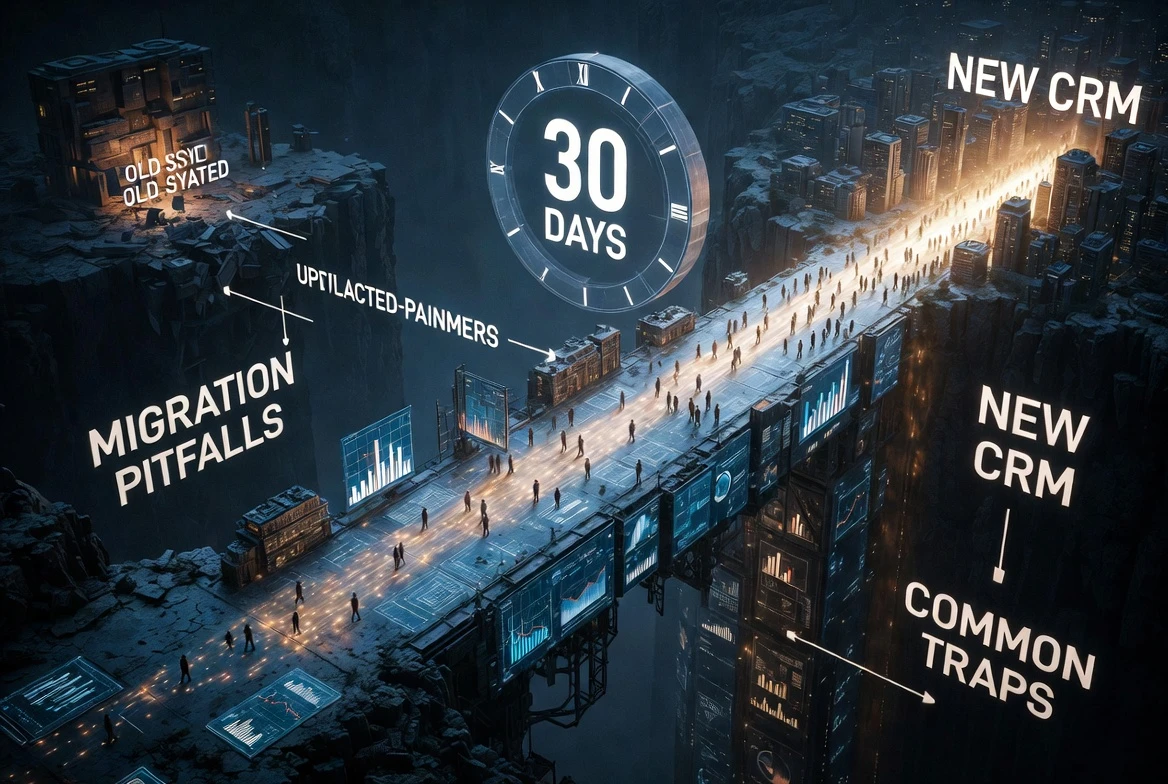
How to Implement Self-Driving CRMs in 30 Days
Week 1: Audit and Platform Selection
Map your current sales process, identify the biggest time sinks, and evaluate three shortlisted self-driving CRM platforms against your tech stack. Focus on native integrations with your email, calendar, and conversation tools. Define your human-approval workflows and success metrics upfront.
Week 2: Data Migration and AI Configuration
Migrate historical data and connect all communication channels. Train the AI on your ideal customer profile, past win/loss reasons, and sales playbooks. Set up custom guardrails for pricing, legal language, and escalation paths.
Week 3: Pilot with High-Performers
Roll out to your top 20% of reps first. Run parallel operations for two weeks so they can compare manual vs. autonomous workflows. Gather feedback and fine-tune the system daily.
Week 4: Full Rollout and Optimization
Deploy company-wide with targeted training sessions. Establish weekly AI performance reviews. By day 30 you will have a live, self-driving sales operation generating measurable lift.
Common Objections and How to Close Them
Objection 1: “This will replace my sales reps”
False. Self-driving CRMs amplify human performance. Reps spend more time selling and less time typing. Every major decision stays with the human. The technology removes drudgery, not jobs.
Objection 2: “It’s too expensive for our size”
Most platforms now offer usage-based pricing with clear ROI within 90 days. The average team recoups implementation cost in under 11 weeks through recovered selling time alone.
Objection 3: “Our data is too messy”
Modern self-driving CRMs include built-in data cleansing agents. They clean and enrich records as they work. You don’t need perfect data to start — you get better data as you run.
Objection 4: “AI can’t understand our complex deals”
That’s why human approval is mandatory at every critical step. The AI handles the 80% of repetitive work; your team handles the nuanced 20% that actually wins deals.
Objection 5: “What about data security and compliance?”
Enterprise-grade platforms are SOC 2, GDPR, and CCPA compliant by default. All actions are fully auditable, and sensitive data never leaves your approved environment.
Objection 6: “Our team will resist the change”
Change management is built into the 30-day plan. Top performers adopt fastest and become internal champions. Results speak louder than any training deck.
The Future of Autonomous Sales: Predictions for 2027–2028
By 2027 self-driving CRMs will evolve into multi-agent systems where specialized AI agents handle entire sub-processes — one for discovery, one for negotiation prep, one for post-sale expansion. Deal-closing probability will reach 94% accuracy 30 days before close.
In 2028 we will see voice-first autonomous selling: AI agents that conduct initial discovery calls, schedule meetings, and even run parts of the negotiation while the rep observes and intervenes only when needed. Full sales operations will run with 70% less manual intervention while delivering higher win rates and better customer experiences.
The organizations that master self-driving CRMs in 2026 will be the ones dominating 2028. The window to gain advantage is now.
Conclusion
Self-driving CRMs have moved from “nice-to-have” to “must-have” for any serious B2B sales operation in 2026. They deliver automation that acts — not just advises — while keeping humans in control of every decision that matters.
You now have the complete blueprint: the technology, the proven results, the 30-day implementation plan, and the answers to every objection. The only question left is how fast you want your sales operation to run itself.
Start today. Audit your current processes, choose your platform, and launch your autonomous sales operation within the next 30 days. The teams that move first will own the future of selling.
Ready to build a sales operation that runs itself? Your self-driving CRM journey begins with a single decision: stop waiting for reps to update pipelines and start letting AI do the work it was built for.