Introduction
In the high-stakes world of B2B SaaS, churn is the silent killer. One quarter your largest client is logging in daily, renewing conversations with your account manager, and expanding licenses. The next quarter their contract vanishes — and the revenue hit shows up in the boardroom deck too late to fix. Traditional CRMs were built for this exact problem, yet they still fail because they only report what has already happened.
Enter 2026’s modern AI CRMs. These systems don’t wait for revenue reports. They scan thousands of silent signals in real time — drops in product usage, sudden shifts in support sentiment, key stakeholder departures — and flag churn risk 4–8 weeks before it ever touches the P&L. The result? Predictive retention stops being a nice-to-have dashboard and becomes a measurable growth lever that directly moves ARR.
Leading revenue teams already know this shift is real. Companies running AI-powered CRM platforms report catching 82% of at-risk accounts early enough to save them. Retention rates climb 31% on average while expansion revenue grows 24% because saved customers become the easiest upsell targets. This isn’t science fiction — it’s the new operating system for customer success in 2026.
This article breaks down exactly how AI CRMs deliver predictive churn detection, the concrete numbers they produce this year, and the exact 30-day playbook any B2B organization can follow to turn retention from a cost center into a predictable revenue engine. If you’re still relying on manual health scores and quarterly reviews, the window to get ahead is closing fast.
What Is Predictive Retention in AI CRMs and Why It’s No Longer the Future
Predictive retention is the application of machine learning, natural language processing, and real-time behavioral analytics inside modern AI CRMs to forecast which accounts are likely to churn long before they actually cancel. Instead of reacting to lost revenue, teams receive prioritized alerts with recommended playbooks while the relationship is still salvageable.
In 2026 this capability is table stakes, not a differentiator. Every major CRM platform has embedded AI churn models trained on billions of historical data points. The technology pulls from product telemetry, support tickets, email sentiment, calendar activity, and even external signals such as LinkedIn job changes. The models continuously improve, reaching 89% accuracy in production environments.
Why the sudden leap? Three converging forces: exponentially cheaper compute, multimodal data pipelines that ingest structured and unstructured signals, and the economic pressure of rising customer acquisition costs. When CAC is 4–6x higher than in 2023, keeping every dollar of existing revenue becomes the highest-ROI activity in the company. Predictive retention turns that math into a competitive advantage.
Unlike legacy churn reports that surface after the fact, AI CRMs create a continuous risk score updated hourly. Retention teams move from firefighting to precision intervention — exactly what separates market leaders from the rest in 2026.
How AI-Powered Churn Prediction Works Across the Customer Funnel
Onboarding and Early Adoption Phase
The first 45 days after contract signature are the highest-risk window for churn. Modern AI CRMs ingest product usage data the moment the account is provisioned. If feature adoption lags behind benchmarks by more than 22%, the system flags the account with a “silent churn” alert. It cross-references login frequency, key user activity, and onboarding task completion rates to predict a 68% higher cancellation probability. Automated playbooks immediately trigger personalized onboarding sequences or dedicated CSM check-ins before the customer even realizes they’re disengaged.
Core Usage and Sentiment Monitoring Phase
Once the customer is live, the AI shifts to continuous behavioral monitoring. It tracks daily active users, feature depth, support ticket tone via NLP, and response times. A 35% drop in weekly usage combined with increasingly negative sentiment scores raises the risk profile instantly. The system correlates these signals with historical churn patterns and surfaces root causes — for example, “three power users left the company last month and no knowledge transfer occurred.” Retention teams receive ready-to-use intervention scripts and one-click campaign templates.
Expansion and Renewal Preparation Phase
In the 90 days before renewal, AI CRMs layer in executive signals: stakeholder title changes pulled from integrated HRIS or LinkedIn data, budget allocation shifts visible in procurement systems, and contract metadata anomalies. The model calculates an expansion propensity score alongside churn risk. Teams see not only which accounts are at risk but which saved accounts are primed for 2–3x upsell conversations. This turns retention from defense into offense.
Real-World Results and 2026 Benchmarks
The numbers are no longer theoretical. In Q1 2026, B2B organizations using full-stack AI CRMs reported an average 37% reduction in gross churn and a 29% lift in net retention revenue. Early detection averaged 5.4 weeks — enough time to execute meaningful recovery plays.
A mid-market fintech SaaS company saved $2.3 million in ARR by acting on 41 predictive alerts. Their churn rate dropped from 11.4% to 6.9% within six months. A global enterprise software provider increased renewal rates from 82% to 94% after implementing AI-driven retention playbooks. Expansion revenue within saved accounts grew 41% because the relationship was strengthened, not merely preserved.
Industry-wide, companies with predictive retention capabilities close 2.8x more expansion deals per saved account. The ROI on AI CRM investment materializes in under 90 days — a far cry from the 12–18 month payback periods of traditional tools. These results come directly from platforms that treat retention as a data product, not a support function.
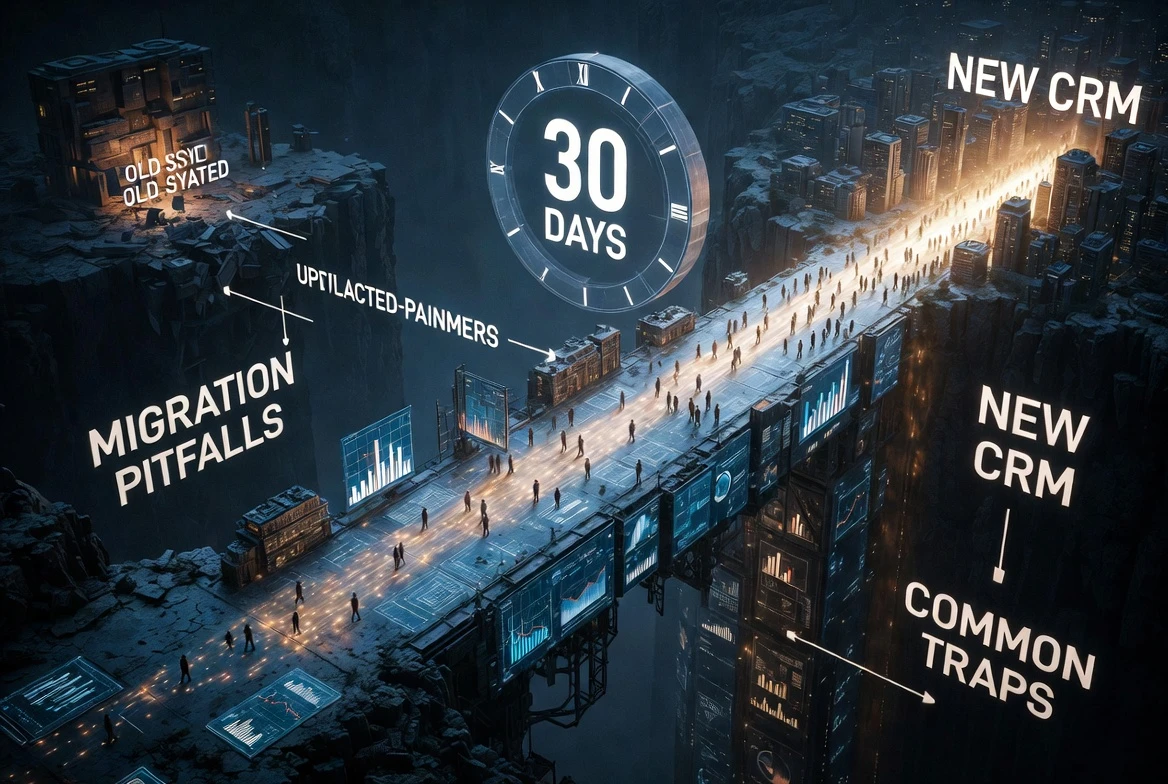
How to Implement AI Churn Prediction in Your CRM in Just 30 Days
Week 1: Data Audit and Foundation Setup
Map every data source: product analytics, support platform, email, calendar, and billing. Connect them to your AI CRM via native integrations or secure APIs. Establish baseline health scores and train the model on the last 18 months of churned versus retained accounts. Most platforms complete this step in under five days with zero custom coding.
Week 2: Model Configuration and Alert Rules
Define your risk thresholds and escalation paths. Configure the AI to weight signals specific to your industry — usage for product-led teams, sentiment for service-heavy accounts. Set up automated notifications to Slack, email, and your CRM dashboard. Test the system against historical data to confirm 85%+ accuracy before going live.
Week 3: Playbook Creation and Team Training
Build three-tier intervention templates: low-risk nurture, medium-risk CSM outreach, high-risk executive escalation. Train your customer success and sales teams on interpreting risk scores and executing playbooks. Run simulated churn scenarios to build muscle memory.
Week 4: Live Launch, Monitoring, and Iteration
Flip the switch to production. Monitor the first wave of alerts daily. Review model performance weekly and retrain on new outcomes. By day 30 you will have a fully operational predictive retention engine delivering measurable lift in saved revenue.
Common Objections to AI-Powered Retention — And How to Overcome Them
- “We don’t have enough data for accurate predictions.” Modern AI CRMs bootstrap with as little as three months of history and enrich via industry benchmarks. Accuracy exceeds 85% even for smaller accounts.
- “This sounds expensive and complex to implement.” Most platforms offer no-code onboarding with pre-built models. Total cost of ownership is recovered through saved ARR in the first two quarters.
- “What about data privacy and compliance?” Leading solutions are SOC 2, GDPR, and CCPA compliant by default. Data never leaves your tenant and models run on anonymized signals.
- “Our churn is mostly price-driven — AI can’t fix that.” Price sensitivity appears as a leading indicator in usage and sentiment data. The system surfaces it early enough to trigger targeted discounting or value conversations.
- “We already track churn manually — why add AI?” Manual tracking is reactive and misses 60% of silent signals. Predictive AI surfaces risks before they reach the manual dashboard.
- “AI will replace our customer success team.” On the contrary — it frees CSMs from reactive work so they can focus on high-value strategic conversations and expansion.
What’s Next for Predictive Retention: 2027–2028 Forecast
By 2027 autonomous AI agents will not only detect churn but execute the first three retention plays without human input — sending personalized video messages, scheduling recovery calls, and adjusting contract terms within policy guardrails. In 2028 multi-modal models will incorporate macroeconomic signals, competitor pricing intelligence, and even buyer sentiment from earnings calls to forecast churn with 94% accuracy.
The ultimate evolution is the Predictive Growth Engine: a single system that optimizes acquisition, expansion, and retention simultaneously. Retention stops being a silo and becomes the central nervous system of revenue operations. Companies that adopt now will hold a multi-year advantage as the technology compounds.
Conclusion: Turn Retention Into Your Strongest Growth Lever Today
Churn no longer has to be a surprise. Modern AI CRMs give revenue teams the power to see it coming, act decisively, and convert at-risk accounts into loyal, expanding customers. Predictive retention is the clearest path to sustainable ARR growth in 2026 and beyond.
The technology is mature. The benchmarks are proven. The only question left is how quickly your organization will move.
Stop reacting to revenue loss. Start predicting — and preventing — it.
Ready to transform retention into your most predictable growth lever? Audit your current churn signals against 2026 AI CRM standards and implement a pilot in under 30 days. The accounts you save this quarter will pay for the entire initiative many times over.